

Congresswoman Alexandria Ocasio-Cortez (D-NY) has stirred up controversy after publicly responding to a dispute with the White House border czar, Tom Homan. The clash began when Homan appeared on Fox News’s “Ingraham Angle” and claimed that he had sent an email to the Deputy Attorney General asking the department to investigate AOC, following her decision to hold webinars teaching illegal aliens how to avoid ICE agents in New York City. According to reports by Jim Hoft on The Gateway Pundit, Homan’s remarks pointed to concerns that her forum might be undermining law enforcement efforts by encouraging behavior that disrupts border security.
The issue escalated when Homan questioned whether AOC’s actions were impeding law enforcement and crossing a line. “At what level is that impediment?” Homan asked. “I’m not an attorney… Is that impeding our law enforcement efforts?” He continued, “If so, what are we going to do about it? Is she crossing the line? I’m working with the Department of Justice and finding out where is that line that they cross.” These comments set the stage for a tense exchange and fueled discussions among conservative critics who believe that actions such as these may blur the boundaries between education and political indoctrination. Critics argue that by holding these forums, AOC gives advice that could potentially weaken the rule of law and undermine the nation’s security.
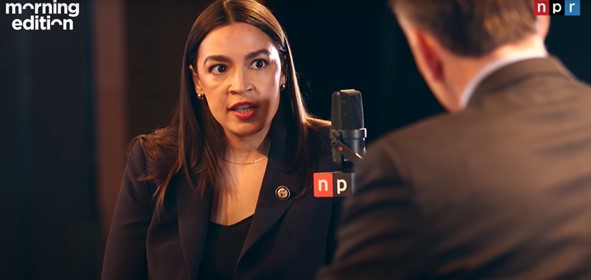
Ocasio-Cortez later appeared on NPR’s “Morning Edition” with host Steve Inskeep to address these concerns and to analyze the administration’s approach during the early weeks of the Trump presidency. During the segment, Inskeep delved into her intentions behind hosting the online forum and whether she had received any feedback or questions from the Department of Justice regarding the inquiry. AOC explained that her goal was to educate the community about their constitutional rights, specifically protecting them against illegal search and seizure. She stated she intended to reach out to the government to ask if her actions had triggered any official review, an effort that shows her readiness to engage with federal authorities to clarify the boundaries of political expression and legal advice.
The tension of this exchange is clearly captured in the transcript provided during the interview:
INSKEEP: You had a recent dispute with Tom Homan…You held an online forum, a “Know your Rights forum,” that he didn’t like. What were you doing? What was your goal as you saw it?
AOC: My job is to educate and act as a liaison of critical information to my constituents, and I was informing all of my constituents of their constitutional protections, in particular, their constitutional protections against illegal search and seizure in the United States.
INSKEEP: Homan was upset, I suppose, because he felt that you were giving advice to people who were here illegally. Were you?
AOC: I was giving advice to ALL of my constituents, yeah.
INSKEEP: He said he was going to report you and that he did reach out to the Department of Justice. Have you heard from the Department of Justice?
AOC: I have not, and I intend to reach out to the Department of Justice to inquire.
INSKEEP: Really? What would your question be for the Department of Justice?
AOC: There is a member of the Trump Administration who is seeking to open an inquiry, and what are you going to do about it?
INSKEEP: What do you hope to learn?
AOC: I think it is important to learn where this administration stands and whether they are going to use political intimidation to silence their critics.
During the program, the discussion also touched on the broader implications of political censorship and the use of federal resources to potentially silence critics. AOC’s actions, including a recent letter sent to U.S. Attorney General Pam Bondi—details of which have been reported by The Gateway Pundit—highlight the rising tensions between political activists and law enforcement officials in a time of heightened political divisions. The controversy surrounding her educational webinar and the subsequent government reaction has become a flashpoint for debates on immigration policy and free speech.
Listeners were encouraged to watch the full interview on YouTube, which has been embedded below along with additional resources. The visual evidence and additional commentary serve as a reminder that debate and dissent have long been part of our American tradition, even as new methods of communication challenge the old ways. This lively exchange between conservative critics and progressive lawmakers continues to spark conversation around what is acceptable in political speech and action. Readers, feel free to leave your thoughts and comments in the comment section below.