
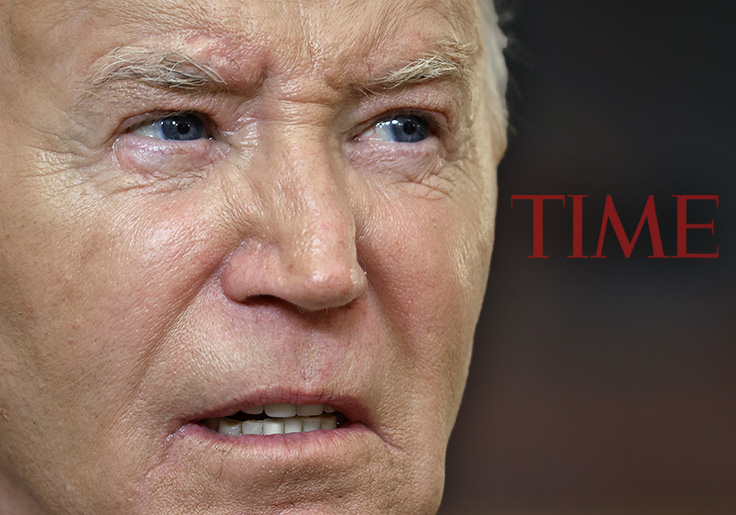

Joe Biden’s presidency continues to be a hot mess, as exemplified by his recent interview with TIME Magazine. His constant inaccuracies and public confusion only serve to further discredit him. This was clearly evident in his handling of the TIME interview, where he once again showed a lack of understanding on policy details and the implications of his decisions.
During the interview, Biden’s propensity for repeating false information was glaringly obvious. He continued to propagate the erroneous claim that inflation was at 9 percent when he took office—a statement that has been debunked even by CNN. In truth, the year-on-year inflation rate when Biden assumed office was approximately 1.4 percent.
The blunders didn’t end there. While trying to justify his new tariffs on certain Chinese imports, Biden confused Russian President Vladimir Putin with Chinese President Xi Jinping—a mistake so glaring that even TIME had to correct it. These gaffes, which have become synonymous with Biden’s public appearances, highlight deeper issues when he distorts facts about his own policies.
Take for example, Biden’s new tariff package announced on May 18, which levies significant duties on Chinese electric vehicles (EVs), solar panels, semiconductors and imported steel and aluminum. Here’s how Biden justified these tariffs:
“If you want to do business in China, you’ve got to have a 51 percent Chinese owner. You’ve got to provide access to all your intellectual property… Sometimes they just outright steal through cyber espionage and other means. And it’s been well-documented and internationally recognized. When you make tactics like these, they’re not competing. It’s not competition. It’s cheating.”
Biden confused Putin and Xi Jinping in his TIME interview — yikes! pic.twitter.com/L0O6oBRwC0
— RNC Research (@RNCResearch) June 4, 2024
Biden’s claim about China’s unethical business practices might be accurate, but his subsequent assertion that these tariffs won’t affect American consumers is highly dubious. His insistence that his tariffs won’t raise prices—unlike Trump’s proposed tariffs—suggests either a lack of understanding of basic economics or a deliberate attempt to mislead.
He argued, “No, because here’s the deal… For example, Trump wants a 10 percent tariff on everything. That will raise the price of everything in America.” But Biden’s argument doesn’t hold water under closer examination. Any tariff—be it 5 percent, 10 percent or higher—typically results in higher costs for the end consumer as businesses pass these costs down the line.
In fact, Biden’s tariffs are quite hefty: a 100% tariff on electric vehicles, 25% on EV batteries, 50% on solar panels and semiconductors, and 25% on steel, aluminum, and ship-to-shore cranes. There are also tariffs ranging from 25% to 50% on certain types of medical equipment. Despite his claims, these tariffs will undoubtedly affect consumer prices—just like any tariffs would.
Moreover, Biden’s use of China’s 51 percent ownership requirement as a justification for these tariffs is misleading. This issue is more about the intricacies of doing business in China rather than the direct economic impacts of tariffs on U.S. consumers.
Both Trump and Biden seem to miss the point when it comes to the fundamental nature of tariffs. When the U.S. imposes tariffs, it’s American businesses that pay import taxes to the government for goods bought from overseas. The financial burden can then fall on various entities including foreign sellers (if they lower their prices to absorb some of the tariff) or American consumers (if businesses hike prices to cover the tariff costs).
Source: Red Right Daily