
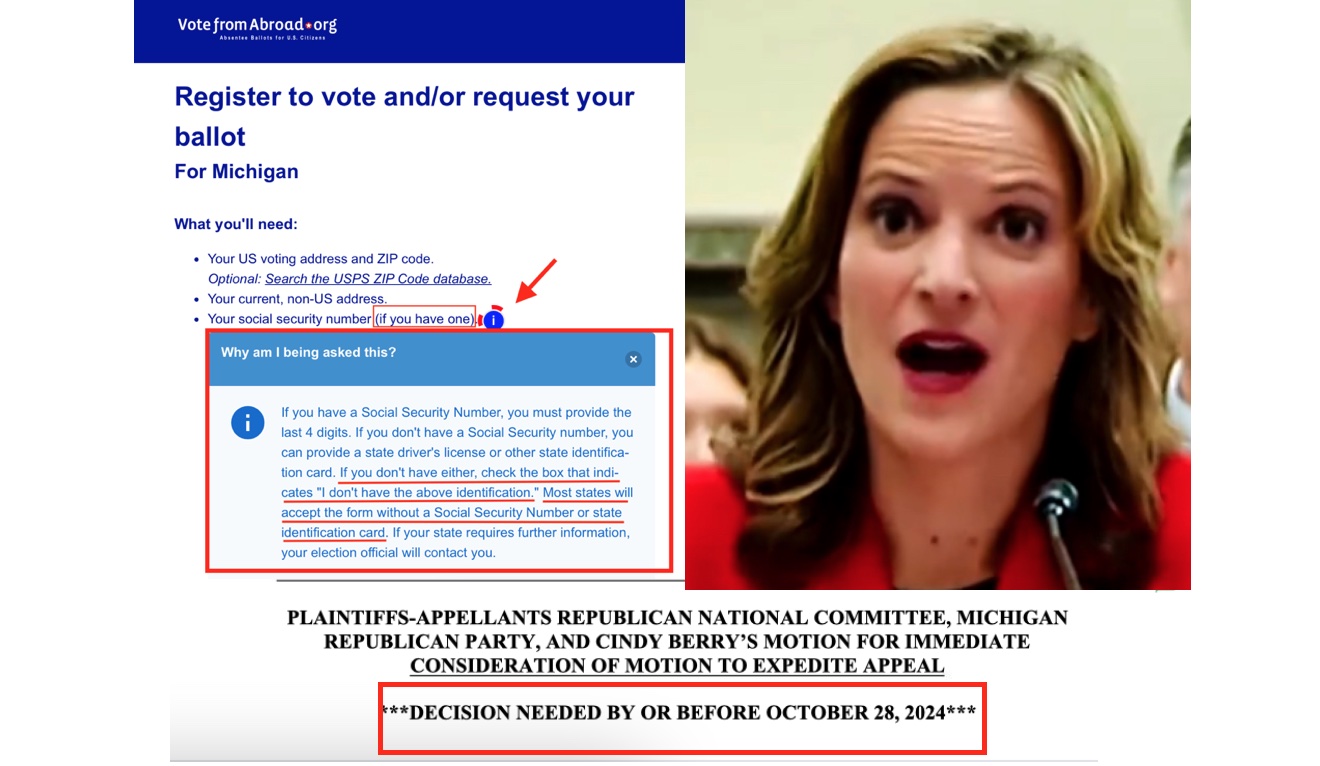

On October 9, the Michigan Republican Party (MIGOP) and the Republican National Committee (RNC) took a bold step by filing a lawsuit against Michigan’s Secretary of State Jocelyn Benson and Jonathan Brater, who heads the state’s Bureau of Elections. This legal action comes in light of ongoing concerns about election integrity in Michigan. Despite having lost ten lawsuits previously, Benson continues to dismiss those who demand adherence to election laws that aim to secure the voting process in the state.
Is it not reasonable for voters to expect their top election official to ensure that basic requirements are met? Voter identification, verification of U.S. citizenship, and checks on signatures and addresses should be standard practices. Michiganders deserve peace of mind knowing that their voter rolls are accurate—that there aren’t deceased individuals still counted as active voters or outside groups trying to register pets as voters. Additionally, there should be confidence that postal workers aren’t violating regulations by improperly handling ballots and that there aren’t more registered voters than eligible ones in numerous counties across Michigan. Moreover, citizens should feel assured that every eligible voter can cast their vote just once during elections.
It raises a significant question: why would any Secretary of State resist implementing these essential safeguards?
On October 21, Judge Sima Patel—a Democrat appointee by Governor Whitmer—dismissed the MIGOP and RNC lawsuit aimed at ensuring only Michigan residents could vote from overseas. The lawsuit called for compliance with the Michigan Constitution regarding voting rights:
“The Michigan Constitution allows Michigan residents—and only Michigan residents—to vote,” states Article 2, Section 1.
In an unexpected twist, the judge characterized this legal challenge as an attempt to “disenfranchise” voters without acknowledging the millions of Michiganders whose votes could potentially be overshadowed by unverified overseas ballots. These ballots could alter election outcomes significantly.
Following this ruling, Jocelyn Benson took to “X” (formerly Twitter) to celebrate what she described as a victory for democracy while misleadingly implying that the lawsuit targeted military voters specifically. In her post, she claimed: “A win for voters and democracy today in Michigan!” She further stated that a federal court had upheld efforts ensuring military service members and their families abroad can vote while rejecting claims made by the RNC as an “11th hour attempt to disenfranchise these electors.”
In response to her assertions, I shared data highlighting how non-military overseas voters outnumber military personnel and their families significantly.
This morning marked another development: MI GOP and RNC filed an appeal against the recent decision from the MI Court of Claims. They are requesting a ruling from the MI Court of Appeals no later than October 28, 2024. The appeal emphasizes that their complaint isn’t focused on MCL 168.759a but rather challenges language within the Secretary of State Election Officials Manual which permits certain groups to register and vote even if they have never lived in Michigan.
To qualify for registration using specific forms like FPCA (Federal Post Card Application) or FWAB (Federal Write-In Absentee Ballot), voters must be absent from their jurisdiction but can include civilians living outside America or active-duty military members regardless of residency status. This means someone who has never resided in America might still be able to vote if they have ties through family members last domiciled in Michigan.
The plaintiffs argue against provisions allowing individuals who never lived in Michigan—such as spouses or dependents—to register based solely on familial connections without fulfilling residency requirements outlined in state law:
“Every citizen of the United States who has attained the age of 21 years…who has resided in this state six months…shall be an elector qualified to vote,” according to Article 2, Section 1 of our Constitution.
The plaintiffs seek clarity on whether this section mandates all voters must have lived in Michigan for six months before being eligible—a requirement they believe cannot simply be overridden by federal law unless those absent had personally resided here previously.
Despite misinformation circulating from state officials regarding this matter, it is clear from their appeal that they do not challenge any existing statutes’ constitutionality but instead focus on ensuring fair representation aligned with established residency laws.
What do you think about these developments? Share your thoughts with us in the comment section below!