
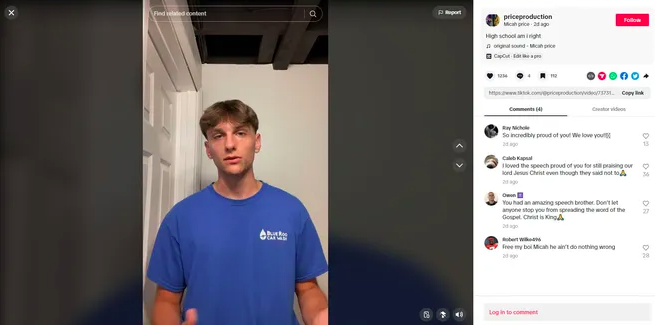

The ongoing struggle to reconcile individual rights with institutional regulations is nowhere more evident than in the case of Micah Price, a valedictorian from Campbell County High School in Kentucky. His diploma was withheld after he dared to mention Jesus Christ during his graduation speech, sparking a national debate.
Despite the First Amendment of the United States Constitution explicitly protecting citizens’ rights to free expression, this blatant disregard by the school administration has once again underscored the tension surrounding religious expression in public schools.
“Congress shall make no law respecting an establishment of religion, or prohibiting the free exercise thereof; or abridging the freedom of speech, or of the press; or the right of the people peaceably to assemble, and to petition the Government for a redress of grievances.”
Price, a stellar student both in academics and extracurricular activities, delivered his valedictory speech before a large audience that included school officials, parents, and fellow graduates.
During his address, Price acknowledged the significant influence Jesus had on his life and attributed his accomplishments and resilience to his faith.
This reference, however, was not well-received by the school administration.
The school principal, Dr. Tammy Muncie, stepped in immediately after Price’s speech and informed him that his diploma would be withheld due to the religious content in his address. According to Dr. Muncie, Price had deviated from the approved speech he had submitted which did not contain any religious references.
“The inclusion of religious content in a public school event is a violation of the separation of church and state,” said Dr. Muncie. “We had an agreement on the speech content and any deviation could result in consequences.”
Supporters of Price argue that this action by the school infringes on his First Amendment rights. Todd Starnes, a conservative commentator and columnist highlighted the broader implications of this incident. “This is a clear case of religious discrimination,”
Starnes asserted. “Micah Price’s speech was a personal testimony, not a government endorsement of religion. The school has overstepped its bounds by punishing him for expressing his faith.”
Price himself has been vocal about the incident. In an interview with the Cincinnati Enquirer, he expressed his shock and disappointment. “I felt it was important to share how my faith has shaped my journey,” said Price. “To be penalized for speaking my truth is disheartening.”
The community’s response to this incident has been divided. While many parents and students have rallied behind Price, arguing that his speech was a personal expression and should be protected under free speech principles, others in the community support the school’s decision, emphasizing the importance of maintaining a secular environment in public schools.
This incident is not just a standalone event but forms part of a larger trend of conflicts over religious expression in public education.
The American Center for Law and Justice (ACLJ), a conservative legal advocacy group, has stepped forward to represent Price, arguing that the school’s action is an outright violation of his constitutional rights.
This case serves as a stark reminder of the enduring complexities surrounding religious expression in public spaces. As communities and courts continue to navigate these challenges, it underscores the ongoing struggle to reconcile individual rights with institutional regulations.
Source: Finish The Race