
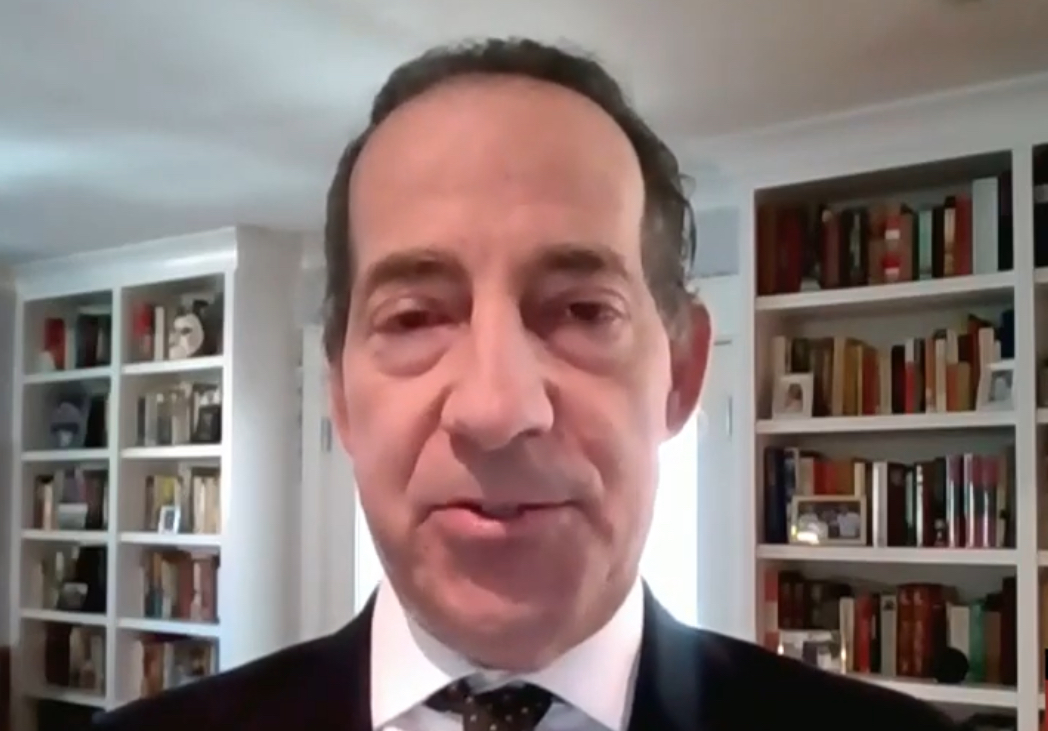

In a recent session of Congress, tension rose sharply when Rep. Jamie Raskin accused former President Donald Trump of using a “racial and ethnic slur” against Senator Elizabeth Warren. During his address to Congress, Trump referred to Warren as “Pocahontas,” a nickname meant to mock Warren’s claims about her Native American ancestry. Raskin, speaking on MSNBC’s Velshi, was quick to point out that this behavior by Trump deserved more scrutiny than the earlier incident involving Texas Rep. Al Green, who was removed from the chamber after heckling the president.
Raskin was passionate as he explained his view, saying, “Al Green was making a very strong, valid, substantive point, which is there is no mandate to destroy Medicaid. The vast majority of Democrats rejected the idea of censuring him. And really, if we were censuring anybody, it should have been Donald Trump, who I don’t think had been back to our chamber since he incited a violent insurrection against us. And then he used his pulpit in order to call a sitting member of the United States Senate Pocahontas. So I think a racial and ethnic slur from the president was a far greater insult to the dignity and decorum of our chamber.” This accusation has stirred debate over the boundaries of respectful political discourse and the role of language in the national dialogue.
The controversy over the use of “Pocahontas” taps into a longstanding debate in American politics about heritage and identity. Pocahontas was a Native American woman from the Powhatan tribe who played a key role in aiding early English settlers at Jamestown. Her story has been passed down through generations, symbolizing both historical interaction and the complexities of cultural identity. Many remember her from the 1995 Disney feature film Pocahontas, which, while loosely based on her life, contributed to the modern myth surrounding her name. For many conservatives, the debate hearkens back to the importance of understanding history in its proper context, without being clouded by modern political agendas.
The incident also highlights the political controversies that have surrounded Senator Elizabeth Warren’s identity claims. The debate first gained national attention in 2018 during her presidential campaign when questions about her claimed Native American heritage became a subject of heated discussion. Amid growing public skepticism, Warren was forced to release a DNA test which confirmed that she had 0.0009765625% Native American ancestry – a fraction that is statistically equivalent to 1 in 1024. In context, this percentage is even less than that of the average American citizen. Reflecting on this, she declared, “I’ve put it all out there, it’s there for anyone to see,” adding further that “Tribal citizenship is very different than ancestry. Tribes and only tribes determine tribal citizenship.” These admissions brought to light how ancestry tests and the concept of tribal membership are used in political arguments and debates.
In the midst of these contentious political moves, audiences have been presented with more than just words. The newsletter features an embedded YouTube clip that shows a brief segment of the exchange, allowing viewers to witness the drama firsthand. Additionally, links remain intact, such as the directing readers to additional details on the controversy via sources like The Gateway Pundit and NPR. These embedded resources serve as a reminder of how interconnected modern news reporting is with social media and online journalism, affirming the importance of transparency and accessibility of the sources being referenced.
The debate over political correctness and respect for cultural heritage continues to permeate Capitol Hill, reflecting a larger national conversation about respect, history, and the proper boundaries of political rhetoric. As these issues evolve, they invite further discussion among the public about both the standards of conduct expected from our elected officials and how historical narratives are used for political gain. Please share your thoughts in the comment section below.