
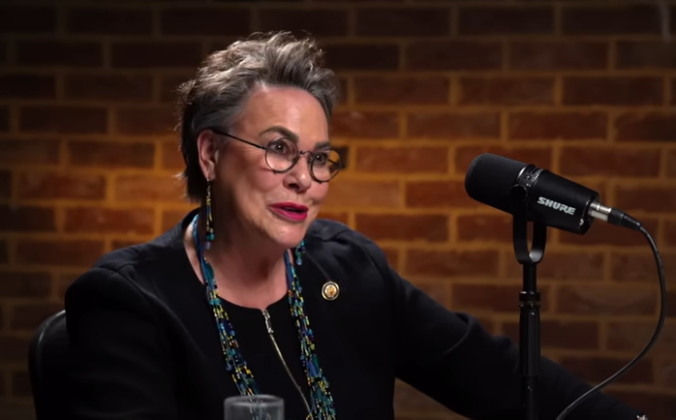

Conservative Republican Representative Harriet Hageman of Wyoming appeared on Winston Marshall’s podcast and shared her strong concerns about waste, fraud, and abuse that have been exposed by the DOGE program. In a clear and direct manner, Hageman used the Department of Education as an example to highlight what she sees as a massive misuse of taxpayer dollars. She pointed out that while the department receives billions in tax money, very little of it actually goes toward helping students learn, leaving billions unaccounted for when it comes to providing education.
Rep. Hageman explained that most of the money, after being funneled through the Education Department’s budget of about $280 billion a year, ends up reaching consultants rather than directly funding educational programs. With less than 25% of the money going directly to educating students, Hageman argues that the remaining funds feed a complicated system of consultants and bureaucrats who then donate money back to politicians and various interest groups. According to her, this process resembles money laundering. She made it clear that so much of this cycle is ripe for reform, provided that action is taken by the very people who hold the power to cut wasteful spending.
In an interview with Real Clear Politics, the conversation unfolded as follows:
WINSTON MARSHALL: So, is the DOGE program targeted at these bureaucrats? And so, how – what can you expect?
REP. HARRIET HAGEMAN: Well, let’s look at the Department of Education. The Federal Department of Education spends – has a budget of about $280 billion a year. Less than 25% goes to educating our students.
So where does the other $220 billion go? It goes to a bureaucracy. It goes to a consultant, and that consultant then donates money back to the Democrats. And then it goes to a different consultant, and then it goes to an NGO, and then it goes to—I mean, it is money laundering and money churning at its absolute best. And you can look at almost every single agency, and you will find it.
So, the brilliance of DOGE isn’t that he’s going in and cutting spending – he doesn’t have the authority to do that. We’re the ones that have the authority to do that. What I want him to do is come up with a report, go through agency by agency by agency, identify every single program that we should not be funding, put a number attached to it.
Throughout the discussion, Hageman’s words were crisp and straightforward, a reminder that transparency in the use of American taxpayers’ money is essential in any government spending plan. Her comments reflect a broader conservative viewpoint that problems like inefficiency and waste should be exposed and reined in by careful review and accountability. The DOGE program, as Hageman sees it, is an important step toward uncovering those hidden flows of money and redirecting them back to where they belong – supporting the people rather than fueling bureaucratic structures.
The interview did not just focus on numbers; it also contained a stark critique of how current systems can allow funds to circulate without proper oversight. The idea that consultants and NGOs may receive far more money than is necessary for their actual function raises serious questions about the priorities of current federal spending. Hageman’s clear message pushes the narrative that this is not just a matter of overspending but of building a system where motives become entangled with politics, and where every penny should be accountable to the taxpayers.
You can watch the complete interview on YouTube by clicking the link provided below. The video offers more details and additional context to the discussion in which Hageman firmly laid out her case for a restructuring of how federal funds are allocated and scrutinized. Readers are encouraged to click on the Twitter embed in the article to see more real-time reactions and perspectives on the matter.
We invite you to share your thoughts and opinions on these issues – please comment in the comment section below.