
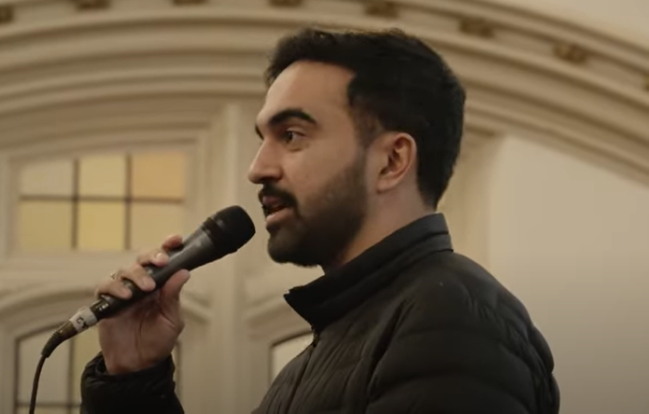

New York City mayoral candidate Zohran Mamdani is making headlines with his proposal to establish government-owned grocery stores in the Big Apple. He envisions these municipal stores as a way to lower grocery prices because they would not pay rent or property taxes and could pass on savings to shoppers. His plan, however, raises concerns among critics who point to history, noting that similar models in the former Soviet Union led to empty shelves and supply challenges.
Mamdani recently boosted his campaign narrative by sharing a survey on Twitter/X that showed support for his idea among New Yorkers.
His confidence in the proposal is clear, and he is pushing for the establishment of “a pilot program of one store in each borough,” reasoning that past studies, including one from Chicago, prove its potential viability. Yet, history remains a point of contention, as opponents recall the negative outcomes of past government-run stores.
Chicago Mayor Brandon Johnson is another political figure who entertained a similar plan. From City Journal:
One of his more curious proposals, about which he is buoyant, is to open city-owned and city-managed grocery stores. His campaign literature explains that these municipal stores will be “focused on keeping prices low, not making a profit. Without having to pay rent or property taxes, they will reduce overhead and pass on savings to shoppers. They will buy and sell at wholesale prices, centralize warehousing and distribution, and partner with local neighborhoods on products and sourcing.”
In a recent interview, Mamdani said that he wants to establish “a pilot program of one store in each borough that builds on the feasibility study that was done in Chicago.” Indeed, in 2023, Chicago mayor Brandon Johnson did propose opening such grocery stores, in response to the closing of many supermarkets in poor areas of the city, and he did commission a feasibility study to examine the question. That study has not been made public, however, and Mayor Johnson has backed off his plan, even though the state of Illinois established a “Grocery Initiative” to provide municipalities with up to $2.4 million to open grocery stores. Chicago has not applied for any of this money.
There are so many ways this could go badly.
Further skepticism arises as critics point out that government control over essential services has repeatedly proven ineffective in past experiments.
Some worry that shifting to a state-run model in a city as large as New York could lead to unintended economic and logistical problems that burden taxpayers rather than help them.
The American left is convinced that socialism will finally work this time, as long as they’re in charge. With citizen feedback coming in on social platforms and historical precedents cautioning against rapid shifts in policy, this proposal continues to stir up debate across the political spectrum. Readers, share your thoughts in the comment section below.